


Recent Graduate Spotlight: Stephen Huysman
As the year comes to a close, we’d like to highlight a recent master’s graduate from Montana State University. Meet Stephen Huysman, who recently finished his thesis examining the influence of climate on major threats to whitebark pine. Learn more about Stephen’s work and experience as a graduate student in this Q&A!
Can you tell us a bit about your masters work?
My research examined the influence of climate on some of the major threats to whitebark pine in order to identify and map refugia where future climate projections show low danger from these threats. I quantified two major threats at broad scales: I developed a wildfire ignition danger rating system for the Middle Rockies ecoregion as well as a spatially explicit model of probability of infection by white pine blister rust, an invasive fungal pathogen, across the Western U.S. At finer scales, I also created a high-resolution water balance model that identifies optimal planting microsites which can buffer seedlings from future drought stress.
What got you interested in studying ecology, and specifically high-elevation pines?
I’m fascinated by plants in general, and ecology is a way to study why plants do what they do or are where they are. High-elevation pines are amazing for their ability to hang on at the edge of existence. Marginal habitats like the tree line where high elevation pines live are difficult places to live but they are where you see some of the most interesting plants because of their adaptations to these harsh environments.
Why is it so important to study high elevation pines?
High-elevation pines are unique in their ability to survive in extreme mountainous environments and play a vital role by supporting other species and regulating ecosystem processes such as stabilizing soil. They are culturally important for Indigenous communities and other cultures due to their symbolism, practical uses, and spiritual significance. They define the subalpine environments they inhabit and their conservation has widespread benefits ecologically, culturally, and aesthetically.
How does your resource help inform management and conservation ?
My work provides data-driven insights to help land managers adapt their conservation strategies to a changing climate. My broad-scale maps of wildfire and white pine blister rust can be used by managers to prioritize landscapes based on projected threats. Within those areas, the high-resolution water balance model identifies optimal planting microsites that can maximize the establishment and long-term survival of costly and limited disease-resistant whitebark pine seedlings.
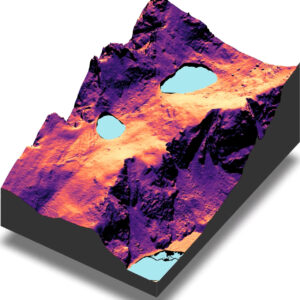
1 meter resolution climatic water deficit for Surprise and Amphitheater Lakes, Grand Teton National Park. Credit: Stephen Huysman
What did you learn about yourself during grad school?
I learned a lot about time management and what it takes to bring a complex project to completion. It was definitely a challenge to balance the unstructured environment of grad school with the need to make continuous progress on my research and all the other demands of life! I also learned that I really enjoy the technical challenge of working with large datasets and I hope to be able to continue to apply the programming and statistical skills I developed in grad school to more big data problems.
What’s next for you!
I’m now working with the Northern Rockies Conservation Cooperative to develop user-friendly tools to explore the models I developed in my thesis and other tools to help inform land management decisions based on climate projections. For example, I am developing web interfaces to view automated forecasts of wildfire danger in the Middle and Southern Rockies based on my modeling work. Developing tooling to work with ecological models is an interesting problem because there is so much scientific data out there that is often difficult to directly explore and make model predictions using new data.